Showing posts with label Triumph. Show all posts

Sunday, March 11, 2012

2012 Triumph America Review

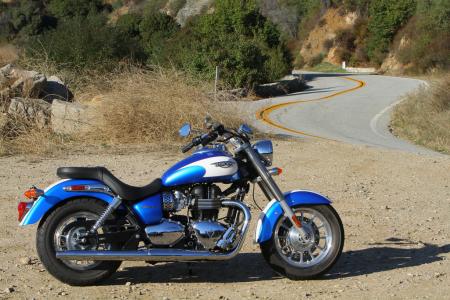
2012 Triumph America Right Side


Think of cruisers, and the usual suspects come to mind: Harley-Davidson, various offerings from Japan’s Big Four, Victory – in fact, nearly every OEM builds a bike to tap into the lucrative cruiser market.


Triumph, better known for its hooligan-making naked roadster Speed Triple or its GS-inspired big trailie Tiger, wasn’t a name that surfaced much in cruiser circles. But that changed in 2004 with the introduction of the Rocket III, powered by a monstrous 2,294 cc (140.0 cu in) inline-Triple. The big, rear-tire-roasting power cruiser had cruiser fans’ heads spinning. Then in 2009 the British bike maker again caught the attention of cruiser lovers with the introduction of the Thunderbird and its large-displacement (1597cc) vertical-Twin, a bike that impressed us so much that we named it our Cruiser of the Year in 2009.
However, before these bruisers burst onto the scene, Triumph already had a model entered in the cruiser genre.


The humble Triumph America is but a blip on the radar when cruiser riders gather to talk shop. Even within Triumph’s world the America sits quietly in the background while the sales-dominatingStreet Triple 675 (and R model) and other sports bikes steal the limelight. Admittedly, even we haven’t given the America much attention in the past 10 years. But a recent ride on a current model year America revealed that shoppers in the cruiser market shouldn’t overlook this cruiser-ish Brit bike.

Triumph America: Not Your Daddy’s Cruiser
In a world of tha-thump-tha-thump-tha-thump V-Twins, the America’s smooth-running, fuel-injected, 865cc vertical-Twin is a unique break with cruiser engine tradition. If you’re looking for a rumbling, raucous ride – one that causes the entire bike to shudder – take note that the America’s 270-degree firing interval has endowed the engine with a quiet-as-a-mouse character when compared to most Harleys and many Japanese cruisers. But if you’re more concerned with enjoying the scenery than about how many passersby are noticing your thundering exhaust, then the gentle Triumph Twin deserves your attention.


Despite the humility of the America’s engine it is by no means ill-suited to motivating the bike’s 550-pound ready-to-ride weight. The America’s as-tested 50 hp at 6500 rpm and respectable 47 ft-lbs at 3400 rpm accelerate the English-made cruiser briskly, with smooth, predictable fueling across the rev range. And while I suspect the engine could easily handle an additional cog in its gearbox, the 5-speed trans nevertheless shifts slickly and is complemented by a light-action clutch.
The first-gen America rolled on cruiser-classic wire wheels, but the most current issue wears 12-spoke cast-aluminum wheels that project a more muscular appearance. Attached to the front wheel is a single 310mm brake disc clamped by a Nissin two-piston caliper, while a 285mm disc and Nissin two-piston caliper slow things from the back. The front caliper handily slows the bike from speed with crisp, authoritative braking action. Applying both calipers simultaneously to retard the America’s forward progress left me wishing that more cruisers in the market offered the same degree of feel and power as what the America provides.
With a chubby-looking front tire (130/90 x 16) the America doesn’t strike the impression of a light-steering cruiser. And the 33.0-degree rake, 5.62 inches of trail and rangy 63.6-inch wheelbase don’t exactly scream “Snappy steering!” Despite these lazy figures the America is anything but sluggish between turns – though the long wheelbase does make tight-radius U-turns challenging at times.
A notably wide, pull-back handlebar allows plenty of steering leverage, and once set into a corner the America is wonderfully stable and tracks accurately throughout the arc of a turn. While the America is a cruiser, it doesn’t suffer from ultra-restrictive lean angle clearance; it will drag a peg, but not as soon as you might expect.
The America’s 41mm Kayaba fork has nearly 5 inches of road-imperfection-gobbling suspension travel. A set of dual coil-over-spring, preload adjustable shocks have 3.77 inches of travel (considerably more than almost any Harley) but provide a slightly firm ride over larger freeway expansion joints and bumps. Generally, though, ride quality is better than average, whether on surface streets or peeling off the miles on the interstate.
In his 2002 review of the America, John Burns said that he thought the America wasn’t “trying desperately hard to look like a Harley-Davidson.” Ten years later that insightful statement is still valid, but for reasons I can’t quite nail down, the America’s styling (with the exception of its engine) strikes me as similar to a Japanese cruiser.
Perhaps the America’s easily seen and inexpensive-looking stamped-steel mount holding the speedo, or the poorly routed clutch cable that brushes against the inside of the left header pipe, are what remind of similar budget-saving tactics I’ve seen time and again on other brands. On the other hand, the judicious use of rich chrome in all the right places offsets some of the less attractive bits.
The America’s ample engine power, more than adequate stopping force and friendly handling make a compelling package. But it’s perhaps the roomy and relaxed ergonomics and large-bike feel and look that stand out as this cruiser’s two most prominent qualities.
 You’ll sit mostly upright in the large, wide saddle (the passenger seat is also roomy), and the sweeping-arced handlebar makes for a natural, easy reach. The footpegs are mounted forward just enough to complete the relaxed rider triangle, yet you never feel like you’re slouching in the seat that’s a scant 27.1 inches off the ground.
The analog speedo’s prominent placement is handy, mirrors provide a clear, useful field of view, and the clutch and brake lever have a 4-position reach adjustment. The layout of the rider environment is such that freeway jaunts of 50-plus miles click off with minimal effort. A small windscreen from the aftermarket would optimize comfort during time on the SuperSlab.
Finally, the large headlight, wide seat, wide handlebar and voluminous 5.1-gallon fuel tank all work to create the sensation you’re aboard a much larger motorcycle without making the America feel overly big or cumbersome.
With a base MSRP of $8299 ($8599 for two-tone colors) the Triumph America is comparably priced to Kawasaki’s Vulcan 900 Classic ($8299 – $8499) or Harley’s Sportster SuperLow ($7999 – $8499) and the V Star 950 ($8490) from Star.

But each of those middleweight cruisers fit roughly within the same mold. The America hits most of the right cruiser notes, but its distinct vertical-Twin power source is refreshingly atypical in this class.
If you’re looking for something a little different without straying too far from the well-worn cruiser path, make sure to give the America a first, and then second look.

2012 Triumph Street Triple R Review

2012 Triumph Street Triple 675R
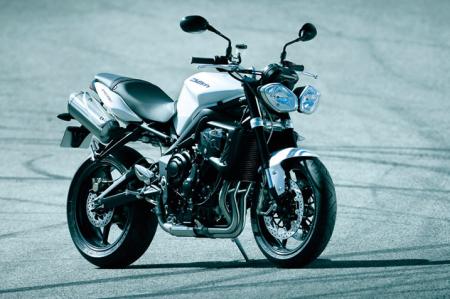
2012 Triumph Street Triple R: Mildly updated but still one of our favorite two-wheeled machines.


Introducing SheilaMoto7000! The world’s first female-form auto-morphing motobot! SheilaMoto7000: The perfect motorcycle that also cooks breakfast!


What’s that you say? Such a machine doesn’t exist? Well, until it does we’re keeping Triumph’s Street Triple R on our Sexiest Bikes of the Decade list. Selected as Motorcycle of the Year 2009 here onMotorcycle.com, Triumph’s Street Triple R has remained a staff favorite since its introduction in that same year.
The up-spec R iteration brings fully adjustable front and rear suspension, along with radial-mount front brake calipers, to the standard Street Triple – making a smart, entertaining bike we liked into a bike we loved instantly. The R’s brakes and suspension are carryovers from the supersport Daytona 675, while the Daytona’s donor 675cc inline-Triple was retuned and remapped with a low-end torque bias for service in the Street Triple models.


Only a few months ago Troy Siahaan informed us that the Street Triple R’s bigger brother, the venerable 1,050cc Speed Triple, lost what was perhaps its most distinctive visual feature: twin round headlights. The iconic dual headlight look is retained but now the lights are pentagonal in shape, and for 2012 the Street Triple R gets the same style lamps.

Triumph has taken a humble approach to touting other updates for the STR, as press materials are light on details with respect to changes for the fresh-faced middleweight streetfighter. However, we learned that a number of subtle, as well visually unnoticeable, refinements join the redrafted headlamps as updates for the 2012 STR.
According to freelance journalist Alan Cathcart’s report, Triumph remedied an issue with the detent spring in the transmission, ostensibly making the 2012 model a smoother, more precise shifting bike. Additionally, the R’s fueling was recalibrated. Triumph’s Simon Warburton explains in Cathcart’s article that the new fuel maps resemble a two-mode mapping (Sport and Leisure), with the EFI system automatically applying different ignition maps depending on how rapidly the throttle is opened rather than just the throttle’s position.
Warburton says, in essence, the end result is a more refined throttle response during tamer, slower riding, while aggressive throttle inputs are rewarded with snappy, quick-revving power.
2012 Triumph Street Triple 675R
It’s difficult to notice in photos, but the exhaust canisters now have a brushed-steel finish, where last year’s model has a chrome finish. The rider’s footpeg heel guards get the same treatment.
Anticipating the Next Great Naked Middleweight Streetbike Bout
The Street Triple has obliterated any class-competitive contenders daring to step into the ring. But for 2012 the naked middleweight funster Triumph has some serious competition in the form of Ducati’s all-new Streetfighter 848.
Just as the Street Triples are stripped down, retuned versions of Triumph’s Daytona 675 supersport, so too is the Streetfighter 848 a repurposed, friendlier-for-the-street model born from Ducati’s middleweight supersport, known simply as the 848 EVO. However, the Streetfighter boasts something that neither the Street Triple nor even the 848 offers: rider-manageable traction control.
But factor out that handy rider aid for a minute, and the Streetfighter still brings some serious punch in the form of its powerful, torquey 849cc Twin and potent radial-mount Brembo brakes. The SF 848 also wears sticky Diablo Rosso Corsa tires.

2012 Triumph Street Triple 675R
Ducati’s new 848 Streetfighter has the Street Triple R squarely in its sights.

Our most recent dyno result for the supersport 848 EVO saw a little less than 119 peak hp joined by 62.0 ft-lbs of torque. The Streetfighter’s street-tune biased Twin will likely churn out something closer to 110 hp. Detuning aside, that’s still a considerable advantage to the 95 hp and 44 ft-lbs we saw from a 2011 Street Triple R during our 2011 Naked Middleweights Shootout.
At the moment it seems the Triumph’s biggest advantages are its 23-pound (wet) weight savings and $3400 less costly MSRP.
Of course, this is a battle between paper lions. We won’t know the whole truth for a few months yet while we await our chance to get a stateside Streetfighter 848 in our hands. In the meantime, here’s a comparative chart to see how they match up on specs.

By the Numbers
Triumph Street Triple RDucati Streetfighter 848
MSRP$9599$12,995
Engine TypeInline-TripleV-Twin
Displacement675cc849cc
Bore & Stroke74.0 x 52.3mm84.0 x 61.2mm
CompressionNA13.2:1
HP (crankshaft)105 bhp132 bhp
Torque50 ft-lbs69 ft-lbs
FrameAluminum beam twin-sparTubular-steel trellis
Wheelbase55.5 in58.1 in
Rake/Trail23.9 degrees/92.4mm24.5 degrees/103mm
Front SuspensionFully adjustable 41mm inverted KayabaFully adjustable 43mm inverted Marzocchi
Rear SuspensionFully adjustable Kayaba monoshockFully adjustable Sachs monoshock
Front/Rear Wheels120/70 x 17 front; 180/55 x 17 rear120/70 x 17 front; 180/60 x 17 rear
TiresPirelli Diablo Rosso CorsaPirelli Diablo Rosso Corsa
Front BrakesDual four-piston radial-mount NissinDual four-piston radial-mount Brembo
Rear BrakesOne single-piston NissinOne dual-piston Brembo
Seat Height31.7 in.33.0 in.
Fuel Capacity4.6 U.S. gal4.4 U.S. gal
Curb Weight416 lbs439 lbs
Cathcart, riding a Euro-spec model, points out the switch from Dunlop to Pirelli rubber on the ’12. But where he says his bike was shod with dual-compound Diablo Supercorsa Pros, our U.S.-spec test unit wore the Diablo Rosso Corsa tire. (Interestingly, the static images in Cathcart’s review show the tires on his bike are also the Rosso Corsa.) Regardless of which Pirelli Diablo model is on your 2012 STR you’re rewarded with excellent grip within minutes of starting your ride thanks to the tire’s quick warm-up time. Handling performance is steady at speed with responsive but predictable turn-in for cornering.
2012 Triumph Street Triple 675R
Chassis geometry remains the same, allowing the Street Triple R to continue its reputation as an ideal canyon carving motorcycle. New Pirelli rubber warms up quickly for lots of grip, matched by excellent overall handling performance.
The softer, satiny look of brushed steel replaces the gleaming chrome surfaces of the exhaust (now with thinner-walled headers) and footpeg heel guards. The clutch and alternator covers now sport a Triumph logo, while the name badge on the fuel tank has taken on a simpler, more contemporary look. Additionally, the cam cover is now magnesium for weight savings and new cylinder liners are said to help reduce engine noise.
This latest iteration of the STR remains a familiar beast, as none of the upgrades and changes altered the bike’s open, upright ergonomic layout. The 31.7-inch saddle height is retained, as is the seat’s thin padding near its front edge. This thin seat complaint is one of our biggest gripes with the STR, so in the scheme of things, that says a lot about the bike’s near-perfect state.

The improvements to the transmission that Triumph says it implemented seem transparent to us since the STR’s gearbox is as smooth as it’s always been in our experience. We’ve rarely taken issue with switching cogs on the Street Triple models. Same goes for the smooth throttle response. The 675cc inline-Triple’s predictable, linear power curve has always been one the bike’s best attributes – thankfully nothing here has changed for the worse.
The mill spins up aggressively, starting around the 8K rpm mark, when grabbing a healthy amount of throttle. This is perhaps the newly calibrated EFI in play. But fueling on this Trumpet model is generally seamless, so we’d need to ride a 2011 against the new 2012 to fully suss out if the new bike’s throttle response is markedly different than last year.
Stainless-steel brake lines as standard equipment help the dual four-pot radial-mount Nissin calipers provide communicative feedback and plenty of stopping force to reel in the STR’s 416-pound wet weight.  Last, but most definitely not least, the raspy exhaust note – with appealing burble and occasional Pop Popon overrun – that we’ve come to love continues to sing its song on the 2012 bike.
The Street Triple R’s notable styling changes and modest mechanical updates, while not earthshaking, nevertheless keep this awesome streetbike at the forefront of a list of bikes we can’t get enough of.
2012 Triumph Street Triple 675R
The Street Triple R has so few flaws and does so much right. We never tire of riding this motorcycle.
An unexpected bonus in light of Triumph’s efforts to keep this bike fresh is an MSRP unchanged from 2011 pricing: The 2012 Street Triple R retails for $9599 ($8899 for the standard Street Triple) and is available in Crystal White, Phantom Black or Diablo Red.

2012 Triumph Speed Triple R Review

2012 Triumph Speed Triple R right profile

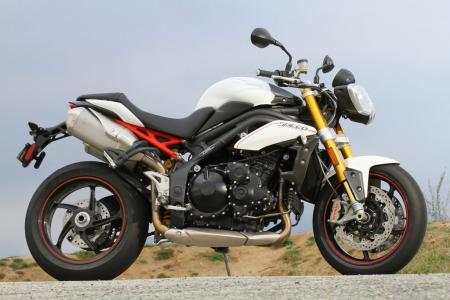
At first glance you might think this is an average Triumph Speed Triple. The gold fork and red highlights reveal that this is actually the Speed Triple R, the more hard-nosed and athletic version of the S3.
When it comes to upping the performance of a vehicle – whether two wheels or four – simply adding the letter R to the name has seemingly become standard practice these days. It’s gotten a bit predictable, actually, and even Triumph has jumped on the bandwagon with the Street Triple and Daytona 675 both recently getting the R treatment, which includes suspension and brake upgrades and of course a few graphic touches to differentiate between the standard models.


It should come as no surprise then to see the iconic Speed Triple as the next in line to receive the R makeover. Specifically, Triumph has outfitted the new Speed Triple R with an Öhlins NIX30 43mm fork in front and a TTX36 rear shock, both tuned with higher spring rates compared to the standard model. Compression and rebound damping in the fork are separated, so each stanchion can focus on its specific task.

Braking duties are beefed up as well with Brembo monobloc calipers replacing the two-piece units on the standard model. ABS is standard on the R model, while still an option on the base version. Futzing with the gauge cluster can turn the system off, but it’s easier said than done.
The next performance modification lies in the wheels. Instead of the cast-aluminum pieces on the base model, R bikes receive forged five-spoke wheels from PVM that, combined shed 3.75 lbs of unsprung weight. Clearly, a big performance upgrade, and the first time Triumph has enlisted forged wheels to complement one of its R models.

The last performance update to the Speed Triple R is a bit harder to see. Transmission internals get a big revamp; 10 of the 12 gears are new, as are internal shafts and shift drum. Shift dogs are up to five (from four on the base model) and ultimately result in a transmission that’s smoother with more positive shift engagement. Further, sixth gear ratio is reduced 3.4%.
As simple as these upgrades sound, they go a long way in transforming the character of the Speed Triple from an average, fun motorcycle, to a lean, mean, canyon carving machine. That’s saying a lot since we’ve been fans of the standard Speed Triple for a long time.
If you’ve been paying close attention, you’ll notice there’s been no mention of any engine upgrades at all. That’s because there aren’t any. The powerplant for both the standard and R version Speed Triple is the same 1050cc inline-Triple that’s become a staple for the brand. It received a slight makeover with the arrival of the revamped standard S3 introduced last year.
2012 Triumph Speed Triple R hp and torque dyno
The 1050cc inline-Triple is among our favorite engines at MO and here’s why: abundant torque practically everywhere in the rev range. But a few extra horses would’ve been nice on an R model.
While it seems Triumph might have missed an opportunity to set the Speed Triple R further apart from the base model, we certainly have no qualms with the torque-monster triple. “It feels like its torque curve is a long plateau, providing effortless thrust until its top end trails off,” says boss-man Kevin Duke.
The standard Speed Triple is a sweetheart amongst the entire MO staff and puts a smile on all our faces each time we ride one. Which actually poses a challenge for the R version: Would all the new bits on the R justify its $4000 price hike over the base model?
2012 Triumph Speed Triple R analog tachometer digital spedometer
An analog tachometer is paired with a digital speedo to relay important information. Progressive blue shift lights atop the tach are a nice feature, though we wonder why a gear-position indicator – as seen on the Daytona 675 and Street Triple – isn’t included.
Hooligan Reformed
First impressions can be deceiving, as is the case with the S3R. Seating position hasn’t changed on the new bike and this “combination of comfy seat and relaxed, roomy rider triangle allows a Speed Triple pilot to ride the bike for long freeway stints in relative comfort,” says Content Editor Tom Roderick.
However, Tom did notice a slight buzziness creeping through the bars at highway speeds. We think this issue could be alleviated if not for the curious lack of bar-end weights. At the very least they would help protect the controls in the event of a tip-over. “But the S3R’s vibration is more noticeable than bothersome,” Duke adds. “It’s a non-issue for me,” and I’m in agreement.
2012 Triumph Speed Triple R cornering
This is where the Öhlins suspension and lightweight PVM wheels make their mark. The S3R steers quick and is planted throughout any corner.
Judging from our relatively comfy freeway impressions, we could have been led to believe the S3R would be a softy in the twisty bits. Once we got to the canyons, however, the Trumpet made it clear it was a hard-edged motorcycle, blurring the line between naked streetfighter and race-ready sportbike.
“It has amazingly neutral steering that is aided by the quicker response offered by its lighter PVM forged-aluminum wheels,” says Kevin. As for the Öhlins suspension, Duke noted the suspension’s stiffer springs result in less pitching while braking and remain higher in their strokes over street bumps. “It feels planted in the corners, more so than the regular Speed Triple.”

Riding quickly is made easier when you’re not worrying about gear changes. On the standard model, occasional mis-shifts would kill acceleration. With the R, however, the many changes made within the gearbox really do work to provide smoother, more accurate shifting. We just wish it came with a gear position indicator like its 675cc cousins.
When dealing with Brembo monobloc calipers, what is there to say that hasn’t been said already? All three testers raved about the binders, with Kevin calling them “simply excellent!” None of us noticed, let alone complained about, any ABS intervention even during our spirited riding moments. Then again, we never had much of an issue with the standard brakes either. Clutch pull could be described as slightly stiff, though old man (or should we say, drama queen?) Tom described the action as "arthritis-inducing."
Triumph Speed Triple R
Ergos on the Speed Triple R are unchanged from the standard version, boasting a comfy seat and a relatively open riding position. It also boasts mirrors that are actually functional, unlike some of its rivals.
 
R Makes All The Difference
It’s amazing the difference high-end suspension, better brakes and lighter wheels can make in transforming a motorcycle. Whereas the standard Speed Triple is more than capable to handle the rigorous testing we performed, when judged against the R it suddenly feels soft. Still, that doesn’t detract from its user-friendliness, as all three testers noted how the Speed Triple R is a familiar, comfortable and capable steed.

On the technology front, some might say the Speed Triple R lacks amenities some of its rivals carry, like traction control. However, with ABS standard, Tom makes a strong case towards not needing much else. “Assuming this bike will be ridden among the hazards of freeways and surface streets, ABS is the preferable technology,” he says.
At $16,000, the Speed Triple R costs $4300 more than the standard model, which begs the question: Is it worth it? The easy answer is: absolutely, assuming you’ve got the money to spend. “Top-shelf Brembo monobloc brakes, Öhlins NIX30 fork and TTX36 shock live up to their reputations and help justify the $16,000 asking price,” Tom notes. Although he added, “For 16 large I’d like to see more than 122 rear-wheel ponies.”
However, for just suspension updates (albeit significant ones) and no additional power, Kevin has a harder time justifying the cost. “I could make a good case for the Triple-R to be judged as an ultimate streetbike, but I’d balk at paying $4300 more for it than a non-R version,” he says. “For my weight, I could live with the standard suspension, so the only really covetous part of the S3R to me its lightweight wheels.”
Personally, I’d agree with Tom. Try to piece together the suspension, wheels and brakes separately and you’d spend much more than four grand. You’d also have a weapon that could not only own the streets, but would also be a riot at a trackday. Which, coincidentally, is exactly where we’re taking the Speed Triple R next, along with two of its contemporaries in the naked bike category, the Aprilia Tuono V4R and MV Agusta Brutale R 1090. Stay tuned for our Euro Streetfighter Shootout to see how they all fare.
2012 Triumph Speed Triple R
At over four grand more than the standard Speed Triple, the R version is a serious jump in price. However, if you can afford it, you won’t be disappointed.
(http://www.motorcycle.com/manufacturer/triumph/2012-triumph-speed-triple-r-review-91245.html)