Showing posts with label KTM. Show all posts

Thursday, March 15, 2012

2012 KTM XC Enduro Line Reviews

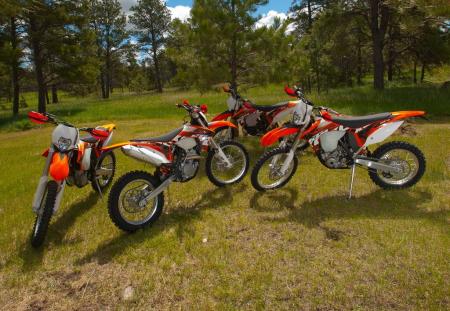
KTM has the widest and most diverse enduro lineup in the industry, and it gets further bolstered for 2012. Four-stroke XCF models are available in 250, 350, 450 and 500cc versions, while KTM continues to serve the die-hard two-stroke aficionados with 150, 200, 250 and 300cc XC models. And most engines have the option of being paired to a wide-ratio transmission, identified by the “-W” designation.
KTM introduced its 2012 enduro bikes at the Inyan Kara AMA National Enduro, in Upton, Wyoming. And once we’d had the opportunity to do a quick evaluation of the various models we were allowed to choose our favorite KTM to race in the enduro the following day. Fun? You bet!

All the bikes feature new bodywork and stronger hand guards, plus a new airbox design with rear-facing intakes that promise to be more waterproof than previous models. Excel rims are used, wrapped in Dunlop tires. WP forks get new seals to reduce stiction and improve performance over small impacts.
The 250cc and 300cc two-stroke XCs get a new frame and swingarm, with a new non-linkage PDS shock. The two-strokes also get a redesigned reed valve to increase torque and smooth out the powerband. The 300 also gets a new cylinder, and both bikes share a new 2.7-gallon fuel tank and more reliable electric-start system.
The four-stroke XCFs received the lion’s share of 2012 updates, starting with a new frame, swingarm and PDS non-linkage shock with a revised rising rate. New cast triple clamps with 22mm of offset improve handling and flex characteristics of the new frame. All the four-strokes get new engine cases that are more pliable than past offerings, meaning they will give a bit on impact rather than crack. The cooling system has been improved, with integrated routing in the frame and new connectors. The 450 and 500 also come with electric cooling fans.

Fuel injection is provided by the latest Keihin 42mm throttle body, with automatic temperature and altitude compensation.
The 250XCF gets a new engine specially tuned for tractability. The generator is now more powerful, and a new silencer and spark arrestor keep the bike quiet and legal. The 350XCF gets an enduro-tuned engine as well, with lower compression (12.3 vs. 13.5:1) than the motocross version to smooth out the powerband. It also gets an all-new new diaphragm spring clutch with adjustable spring preload that is shared with the 450 and 500.
Like the 250, it gets an improved 196-watt electrical system and new 2.5-gallon fuel tank. The new 350F engine is purported to weigh just 62.8 pounds, including the electric starter, kickstarter and exhaust flange! With cylinder-head improvements, the 350 likes to rev, with the rev limiter set at 12,000 rpm. The six-speed transmission is ‘semi-close ratio’ with no big gaps to allow seamless power delivery. The valve train features new cam-chain guides and a simple spring-loaded ratcheting chain-tensioner system.
The 500XCF is big news, with a new SOHC engine, die-cast engine cases, multi-function balancer shaft, lightweight piston and Pankl connecting rod. The 500’s engine was designed to be reliable and simple to maintain, with the lowest possible weight and size.
All the four-stroke XCF-W models are California Green Sticker-legal, and come with special tamper-proof emissions equipment. For closed-course racing, authorized KTM dealers can make tuning changes.
That’s the tech scoop. But what are they like to ride? Before we go too far, I should mention that I am 165 pounds wearing riding gear, and the area we did our preliminary testing was a combination of gravely soil, fairly tight trails and high-speed two-track. Some things were consistent across the line, like excellent ergonomics, best-in-the-business brakes and a solid, strong overall feel. All the bikes have quiet exhausts, though the two-strokes do not come with a spark arrestor and are sold as ‘closed-course only’ machines.
The two-stroke 250XC-W feels exceptionally light and responsive, especially if you’ve gotten used to riding a four-stroke. Gear ratios, shifting and clutch worked great, as did the fork. The rear suspension is decent, and the new frame did give the 2012 a little better stability than past KTMs. It was fun to ride, and the snappy two-stroke powerband made us feel fast and reminded us how cool it is to ride a smoker.
But feeling fast and being fast are too different things, and while the 250XC-W was smooth and pulled hard, it still did it over a much shorter range than a four-stroke. You are always conscious of the fat two-stroke expansion chamber sticking out in the wind begging to get smashed. But that’s life with a two-stroke. On a tight course with a sharp rider the 250XC-W will fly, and it feels so light you just want to hop logs and look for jumps. But get sloppy and tired and you’ll soon be watching lazy four-stroke riders with envy.
The 300XC-W is the most popular bike in KTMs Canadian line, and for good reason. Nothing makes the instant bottom-end torque of the 300 – not even a four-stroke. It pulls hard, too, and while the powerband is short compared to a Thumper, the gear ratios and light feel of the 300 make this a very effective race bike. It is perhaps the most effective and versatile two-stroke ever built. Both KTM two-strokes thrive on ‘cut and thrust’ situations, where their strong braking power, agility and quick bursts of acceleration out of turns really pay off. One thing’s for sure, the KTM two-strokes are stone-axe reliable and have a loyal following.
The 250XCF-W was a mixed bag for us. It feels light, handles better at speed than the two-strokes, and even suspension feels more solid and controlled. That can be chalked up to the silky smooth powerband, which lets the whole chassis relax rather than skitter around like a two-stroke. It pulls okay, but not as hard as KTM’s motocross 250F or any other 250F MXer you’ve ridden lately.
In tight, slippery conditions the 250XC-W would be ideal, but on faster terrain you’ve got to work hard to keep up your momentum. The clutch and gearbox are excellent, which is good because to maintain speed in the open sections you’ve got to ride this bike very aggressively. We liked it, and it would be a great choice for slippery Eastern singletrack, but on the fast and loose trails at our test area in Wyoming, it simply made us work too hard.
The 450XCF-W surprised us by feeling nearly as agile as the 250XCF-W. It makes good, smooth power, never feels heavy or intimidating, and doesn’t hint at stalling or flaming out. It was confidence inspiring to ride, but the rear suspension did feel a little underdamped compared to the lighter, slower 250XCF-W. Like the rest of the 2012 KTMs, the WP fork is excellent. We liked this bike a lot, and it was our favorite bike up to this point of the day.
The 500XCF-W was a nice improvement to the old 530. It feels smaller and lighter than its predecessor, with strong torque that makes it easy to ride in the open sections or in the woods. This would make a killer play bike! But as a race bike it does feel a little cumbersome in the woods, and the rear suspension does feel too fluffy for the speeds of which this bike is capable. We’d be happy to ride it all day, but race it? Maybe if we grew another 6 inches taller and gained 40 pounds. The 500XCF-W was simply too much motorcycle for this little old writer.
We were able to ride all the cross-country ‘W’ wide-ratio transmission models except for the 150XC and the 200XC-W, so impressions of those will have to wait till a later date.
Which leaves us with…
The KTM 350XCF-W. We’ve read all about the 350. We’ve heard people say it was a slow 450, or a cheater 250F. Well, it’s sort of both of those things. It is physically lighter than the 450 by just a few pounds. We’ve ridden mildly souped-up 250F motocross bikes that can outrun it. The suspension is excellent up front and average in the rear. It doesn’t exactly sound like a winning combination, but trust us, in the real world it is.
Of all the new KTMs we rode in Wyoming, the 350 is the one we’d most like to have in our garage. It became the benchmark for all the other KTMs at our disposal, and we ended up begging KTM to let us race it the following day. But that’s another story, so stay tuned for the complete 2012 KTM 350XCF-W race test!
KTM 2012 Manufacturers suggested retail price, USA:
Two-stroke
  • 150XC: $6999
  • 200XC-W: $7099
  • 250XC: $7999
  • 250XC-W: $7999
  • 300XC: $8099
  • 300XC-W: $8099


Four-stroke
  • 250XCF: $8299
  • 250XCF-W: $8299
  • 350XCF: $8999
  • 350XCF-W: $8999
  • 450XCF-W: $9199
  • 500XCF-W: $9399


(http://www.motorcycle.com/manufacturer/ktm/2012-ktm-xc-enduro-line-reviews-91065.html)

2012 KTM 350 XCF-W Review

2012 KTM 350 XCF-W
Not only is the 350 XCF-W more stable and solid feeling than KTM’s two-stroke XC models, it’s also got the best brakes in the business.
When KTM’s 350cc project was announced, riders and the media were excited about the prospect of a lighter and easier to handle open-class machine. When the bike arrived, however, the motocross media said it was only slightly lighter than the 450 and had much less torque, running more like a fast 250F. Still, the machine has won motocross races all over the world, plus KTM had considerable success at off-road races with riders aboard converted 350SX motocross bikes.


For 2012 KTM has done the off-road conversion for you, with a wider-ratio transmission and engine modifications that make the aggressive powerband more appropriate for off-road racing. The new frame uses the non-linkage WP PDS shock, which KTM swears works better off-road. A host of improvements to the clutch, engine cases, fork, tripleclamps, rear suspension shock position and ergonomics highlight the major changes. KTM also improved the electric-start system and added a more powerful 190-watt electrical system to power FIM enduro-legal lighting. The new exhaust is spark arrested and quiet, and the tamper-proof EFI settings ensure EPA and California 'Green Sticker' compliance.

At the KTM 2012 XCF-W press launch at the Inyan Kara AMA National Enduro in Wyoming we had the chance to try all of the new KTM cross-country bikes before picking one to race. Being diehard two-stroke lovers, we thoroughly expected to choose the familiar 300XC-W to race. That opinion changed quickly when we climbed aboard the 350XCF-W. The bike felt acceptably light, handled better at speed than the two-strokes and had the smoothest powerband this side of an XR100. As the journalists swapped bikes during the day it was always the 350 that we couldn’t wait to ride again, and it became the bike the other models were judged by. With just two 350s at the media's disposal for racing we got our elbows up and smashed our way to the front of the line to book the 350XCF-W as our AMA National race bike!
What's it like? Well, hoist it onto a bike stand and you'll feel that it is only a little lighter than the 450 version. The new plastics have improved rider ergonomics, so the bike is immediately comfortable either sitting or standing. All the normal KTM-isms are apparent; KTM motorcycles have become more mainstream than ever, but they are still KTMs, meaning they feel a little different to ride and are put together with different-sized fasteners than Japanese offerings. One thing for sure, nothing about the KTM feels cheaply made, and everything is designed to be functional.
The hydraulic clutch uses a new diaphragm-type single spring, which is adjustable for preload. The light pull and progressive feel are excellent. Despite EPA-compliance, the 350 has sharp, instant throttle response and a satisfying yet quiet exhaust note. The electric starter fires the bike up pretty quickly, but to be honest, the bike starts faster when you use the kicker.

Run the 350 hard through the gears and you'll feel a little disappointed at first. There's no bottom-end hit and no surge of raw power. The 350XCF-W has a flat and featureless powerband that keeps revving long after a 450 would have signed off. Ride it back to back against the KTM250XCF-W and it's apparent the 350 makes substantially more power at all points, but never enough to be intimidating or even all that exciting. While we have ridden plenty of souped-up 250F motocross bikes that pull harder, we knew from experience that the workman-like powerband of the 350 would make it an excellent enduro race bike.
Here are some random notes from our race test at the Inyan Kara National Enduro:
-The KTM 350XCF-W gets amazing traction, thanks to that incredibly smooth powerband. The power delivery is confidence inspiring, and you always know what will happen with no surprises.
-Overrev! This bike will scream (the rev-limiter is set at 12,000 rpm) so don't waste your effort shifting out of second in the woods. There isn't much low-end torque, but it does have nice hook at the top of the powerband where it starts to breathe hard! Besides, revving it in second gear avoids the gappy-feeling second to third gear tap dance. We’d love to try the close-ratio XCF version!

2012 KTM 350 XCF-W
Our first ride on the 350 was a bit of a letdown after riding the 450. The smaller engine pulls so smoothly it’s almost boring. Smooth doesn’t mean slow, however, especially when it’s slippery and you’ve already spent three hours in the saddle.

-While you don't need to clutch the 350 as often as you do a 250F or a two-stroke, the lack of low-end hit does require a little zap of clutch out of corners and over surprise obstacles that a 450 would hop over with just a twitch of the throttle.
-Stability is excellent. We never thought we'd say that about a KTM, but this bike feels solid at speed. We had it buzzing too, to the tune of 80-plus mph in sixth gear a few times on the desert-like transfer trails of Inyan Kara.
-Brakes are beyond excellent. They don’t fade and are super-strong and progressive. We're chronic rear brake draggers and have overheated KTM rear brakes in the past to the point the wheel wouldn't turn. This is certainly not the case on the new 350, which never showed any signs of rear brake trouble at all. For the record, there is very little engine braking, at least when compared to a 450.


-The 350 never feels as heavy as a 450, and in fact turns just as well as the 250 in the woods. This is a comfortable all-day race bike.
-The electric starter struggles if you happen to stall the bike when it's really hot, taking a lot of cranking before the engine finally re-fires. We've noticed this with other brands of EFI 'green sticker' four-strokes as well, so perhaps it is an overly lean fuel/air setting that causes this. In any case the bike didn't stall easily and never flamed out, farted, barfed or did anything but run nicely.
-The clutch might be a little too light; a couple times, when running wide open in top gear under a heavy load, we felt it slip a little. A stiffer preload setting on the clutch diaphragm spring might help.
-The front fork is great. We never had the urge to even touch a clicker. It had great small-bump compliance and is still able to soak up bigger hits and even some abrupt jump faces without a problem.

2012 KTM 350 XCF-W
KTM’s proven non-linkage PDS shock works better than ever with a new shock angle and positioning, but it still lacks the multi-terrain versatility of linkage designs.

-The rear suspension is a little better than past PDS systems, but the rear of the bike still wallows through fast sandy berms and whoops and blew through its travel on high-speed G-outs, sometimes to the point of making us nervous. When we adjusted it to soak up that stuff, the rear end kicked over roots and small logs. We slowed down the rebound and increased the compression, which helped a little, and dealt with the subsequent harshness over trail junk. We could have probably found a better setting if we’d had more time to experiment, but we have to wonder why KTM didn’t just use the shock linkage like they did on the motocross version.
2012 KTM 350 XCF-W

So how’d we do on the 350 at Inyan Kara? Fourth in class! Would we race it again? Absolutely! The bike was gentle to ride but had enough beans for the open stretches without ever getting unruly. It felt light enough, was solid and handled well. With more time tuning the rear suspension, we’re sure it would handle better.
If this were our personal bike, we'd get a KTM suspension specialist to set up the shock for us. KTM dealers can alter the EFI for closed-course racing, and we'd do that and add a less restrictive pipe to give the powerband just a little more snap. We'd increase the clutch spring tension, add a tooth or two to the rear sprocket to help overcome the second-to-third shift gap, add a skid plate and radiator guards and go racing! We'd even use it for moto; the 350XCF-W would be a good Vet-class motocross bike, especially on rough and slippery tracks.
So who should buy this bike? Well, us, for starters. If you're a racer and a 450 is just too aggressive or big, you'll love the 350. It can't help but be more reliable than a souped up 250F and will just about hang with the 450s in the open stuff. In the woods it's fantastic, the tighter and gnarlier the trails the better. The 350XCF-W would be a fun hardcore play bike too. We love it, but if you want one you'd better stand in line behind us!

2012 KTM Street Model Lineup Preview

When dipping its toes back in the streetbike market, KTM did so gently with the single-cylinder Duke models. But when the company decided to finally hit the ground running and introduce a slew of street models, it still did so in a conservative fashion. The company’s headliner, the RC8 superbike, lacked power compared to its rivals, and the fit and finish was still a little rough around the edges. That said, KTM designers nailed the chassis design from the start, as it’s one of the best handling motorcycles we’ve ridden. The RC8 R aimed to fix the power issue by bumping displacement from 1148cc in the base model to 1195cc — rivaling its V-Twin competition — but now that power wasn’t an issue, taming it was.

Taking the “Ready To Race” motto to heart, 2012 sees six street bikes in the KTM lineup, headlined by the RC8 R and RC8 R Race Spec models. Here’s the breakdown:
RC8 R
Both the RC8 R and RC8 R Race Spec enter 2012 enjoying a host up carry-over upgrades from 2011. Since the RC8s were late arrivals to the 2011 sportbike party, we’re highlighting the changes and upgrades.
The 1195cc, 75-degree V-Twin remains; enhanced with dual spark plugs for better combustion, and new camshaft timing, the RC8 R now matches the increased power of its club racing kits. A forged crankshaft receives an additional 100 grams of weight for more inertia and when combined with a 25% heavier flywheel the result is a reduction to the abrupt throttle response for which the RC8 was notorious. But that’s not all, the 52mm throttle bodies now have an idle speed control cam to allow smoother airflow in the initial range of movement, like when applying throttle exiting a corner. Of course, this change in airflow required the ECU mapping to be tweaked to compensate.

The gearbox wasn’t ignored either when going over the RC8 R. Of note is a gearbox sensor that allows the ECU to help control engine braking depending on the current gear. This will help reduce rear-end chattering when diving deep on the brakes for a corner. Other improvements to the tranny include a revised drum and linkage to save weight and provide better shifting.


In the suspension department, the front fork received a larger air chamber (110mm vs. 80mm), while the rear shock’s spring rate is reduced from 95 to 85 N/mm. Both changes provide a better compromise for street riders who want a more comfortable ride, but who still take their RC8 to the track occasionally. Rear ride height now receives a larger range of adjustment, with the rear linkage eccentric adjustable up to 12mm.
2012 KTM 1190 RC8 R
More inertial mass in the crankshaft and flywheel should help smooth throttle response, while dual sparkplugs promote cleaner, more efficient combustion, resulting in slightly more power.
The rider interface is slightly revised as well, with the gear indicator in both Street and Race mode shown in two places; as a line under the RPM and as a numeric display. Instant and average fuel economy is updated every three seconds, and speaking of fuel, the RC8 R now has an option to switch between two different fuel maps depending on the quality of gas available, with the default 91 octane setting good for a claimed 170 horsepower. The second setting, set for 94 octane, can reach a claimed 175 horses. As far as electronics, the RC8 R doesn’t receive traction control like many of its counterparts, unfortunately, but it still looks to be a worthy competitor in the literbike wars. Finally, its headlight is now surrounded by LED marker lights. Attention was given to not only bump power slightly, but moreso to manage it. Pricing is TBA
RC8 R Race Spec
Upping the ante for the serious trackday or racing enthusiast is the RC8 R Race Spec, which practically throws the proverbial “kitchen sink” of parts from KTM’s performance catalog onto the RC8 R. Specific to the 2012 RC8 R Race Spec are new suspension settings and a new countershaft sprocket with an additional tooth, now 17. To create the Race Spec the base RC8 R is stripped of its street plastics and fitted with track versions instead, with no cutouts for lights or mirrors. Next comes an Akrapovic Evo 4 titanium exhaust system, thinner head gasket, and more aggressive cam timing (a tool to adjust the cam timing is also included). A freer-flowing air filter is installed, while the race ECU is programmed to match the new engine components. This is mated to a racing wiring harness which eliminates all the unnecessary wires (like those that operate the lights), all in the name of weight savings. All told, the Race Spec engine puts out a claimed 180 horsepower and 97.4 ft.-lbs. of torque.
2012 KTM 1190 RC8R Race Spec
The Race Spec version of the RC8 R is a trackday enthusiast’s or racer’s dream, as it incorporates practically every go-fast part in the KTM catalog.
Also included in the Race Spec is a slipper clutch and quickshifter for the GP-style (reverse) shift pattern which comes standard. A WP 4618 race shock is fully adjustable, while the WP fork receives TiAIN coating for the slickest surface possible. Both units are tuned specifically for the Race Spec chassis. Forged Marchesini aluminum wheels shave some weight off the stock bikeand are mounted to Dunlop race slicks.
Other notables include machined adjustable footpegs with carbon heel guards, adjustable race brake and clutch levers, 520 chain and sprockets, high-performance brake pads, quarter-turn racingfuelcap, carbon engine guards and a bike stand from Power Parts. Pricing is also yet to be determined for the RC8 R Race.
990 SM T ABS
2012 KTM 990 SMT
KTM’s interpretation of a sport-tourer, the 990 SM T ABS comes with soft luggage (not pictured) for long-ish travels.
Making a return to our shores is a revised version of the 990 SM, only this model gets a T designation for touring, along with the addition of ABS. It’s powered by the venerable 999cc, 75-degree V-Twin we saw in the Super Duke (which, sadly, isn’t coming here) and comes with soft saddlebags as standard equipment. KTM partnered with Bosch to use its two-channel anti-lockbrake system as an added safety feature on the SM. Dual Brembo four-piston, radially mounted calipers bite on 305mm discs and are fed fluid through a radially mounted master cylinder with steel braided lines. Pricing and availability are yet undetermined.
990 Adventure ABS/Adventure R
If you’ve ever seen the notorious Paris-Dakar rally, then you’ve definitely seen the workhorse of the KTM lineup, the 990 Adventure. The 2012 model year sees the Adventure get spruced up with two new variants with the ABS and R models. The former is based on the 2011 Adventure Dakar edition, powered by the same 999cc V-Twin that puts out 115 hp. Only now it receives the benefit of ABS. It also gets a factory racing orange powder coated frame and engine guards, revised wrap-around hand guards, a modified centerstand for easier lifting and new colors and graphics.
2012 KTM 990 Adventure
The go-anywhere 990 Adventure ABS retains all of what makes the Adventure a Paris-Dakar winner while adding ABS. Meanwhile, the Adventure R (not pictured) benefits from suspension tweaks.
The Adventure R model benefits from suspension tweaks that provide 9.8 inches of travel for aggressive riding. A lower seat height of 35.2 inches is almost one full inch lower than the 2010 model. Ground clearance is now set at 11.7 inches.
690 Enduro R/500EXC/350EXC-F
Lastly, a trio of on/off-road models make their way for 2012, starting with the 690 Enduro R, which gets a true 690cc engine due to longer stroke. This increases power to a claimed 67 hp and 49 ft.-lbs. Service intervals have been extended to 6200 miles (10,000km), while suspension settings receive new spring rates, resulting in total travel of 250mm. Seat height now drops 20mm to 910mm, while a new seat adds more comfort. A new tank spoiler, front mask and fender combine to give the 690 Enduro R a new look to go along with the new and improved headlight.
Sadly, the new 690 Duke announced at EICMA apparently won’t be coming to America. 
2012 KTM 690 Enduro
For the dual-sport fans out there, the 690 Enduro gets even more power for 2012 and an extended service interval.
The 500EXC and 350 EXC-F are practically completely revised motorcycles. The 500EXC features a new 510.4cc SOHC fuel-injected engine that’s 5.5 pounds lighter than previous the previous powerplant. The 350, meanwhile, sports a 349.7cc DOHC fuel-injected engine. Internally, both engines receive a new balancer shaft, lighter piston and connecting rod and a new single diaphragm spring clutch. A new electric start system has a kickstart backup and is paired with a stronger stator rated at 196 watts. The frame and swingarm are new with a PDS shock in back. Black Giant-brand rims and spokes adorn each bike, and each gets a new airbox, intake boot, silencer and spark arrestor. New bodywork includes a translucent fuel tank and in the rear the taillight and license plate holder is beefed up to be more durable. The 500EXC will retail for $9899, with the 350 coming in $200 cheaper.
2012 KTM 350 EXC F
Trail riders out there will enjoy the 350 EXC-F, though some might opt for the more powerful 500EXC (not pictured).
(http://www.motorcycle.com/manufacturer/ktm/2012-ktm-street-model-lineup-preview-91175.html)

2012 KTM 200 Duke Review

2012 KTM 200 Duke Front Right

The 200 Duke was developed jointly by KTM and Bajaj Auto.
Austrian company KTM is an acknowledged champion when talking off-road motorcycles, as the Austrian firm has made it a habit of dominating off-road motorsports events. The KTM 200 Duke is the first streetbike to be jointly developed between them and Indian motorcycle maker Bajaj Auto, whose stake in the European firm has now crossed 39%.


The single-cylinder 125 Duke was introduced about a year ago in select European markets, where it’s charged into the lead and become a segment leader, which makes it no surprise the 200cc variant has been so eagerly anticipated.
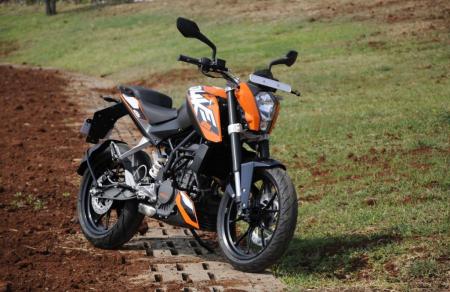
Butch, lean and aggressive all at once, the striking 200 Duke proudly shows off its KTM genes. Black and trademark orange are the predominant colors, while sharp angles and steep creases define this modern naked bike. Every part has been visibly pared down to a minimum, which allows the 200 to live up to KTM’s ‘ready to race’ tag and tip the scales at just 300 claimed pounds.

The front mudguard is sporty, bolted on above elegant, slim-spoke alloy wheels. A bikini fairing guards the sump, while the engine itself is exposed between the motorcycle’s steel-trellis frame. A stubby exhaust box sits neatly tucked away underneath.

There’s a chin-set auxiliary light below the headlight, while a compact digital instrument cluster sits over this. We found ourselves struggling to view the tiny, cascading rev counter and other info relayed by the dinky readout. Only speed is prominently displayed and easily legible.
The 200 Duke comes with illuminated switchgear that works with crisp clicks, plus a comfortable set of levers and functional mirrors. The 10.5-liter (2.8 gallon) fuel-tank offers deeply recessed, snug thigh support, and the saddle is roomy and well padded, although the same can’t be said for the compromised pillion seat. Split alloy grab bars lead to a slender tail lamp, behind which extends a lengthy mudguard and number plate holder. The rear tire hugger looks a little awkward, but we like the sleek, clear-lens turn signal indicators. Overall quality, including rubber and plastic parts, is good.  

The KTM Duke 200 is powered by a single-cylinder 199.5cc four-stroke engine, an oversquare arrangement with a 72mm bore and 49mm stroke. It’s a fully modern design, with fuel-injection, liquid-cooling, and a pair of cams driving a quartet of valves. Drive goes through a compact six-speed gearbox then a chain.
The KTM Duke fires up and emits an enjoyable, deep exhaust rumble. Its clutch is well weighted and progressive, and gears shift with precise action. Throttle response is immediate and decisive from its large 38mm throttle body, although we did notice the fueling feeling unsettled between a narrow range just over idle to 3000 rpm, where we had to play the throttle to keep revs up and the engine firing smoothly.
Revved higher, the mill delivers a wide powerband with excellent midrange and top end muscle. The 200 Duke has an addictive surge of smoothly delivered power, kicking in strongly from 4500-7000 rpm before transforming into manic mode as it rushes to crash into a 11,000 rpm redline. KTM claims a peak of 25 horsepower at 10,000 rpm.
2012 KTM 200 Duke Action Front Right
In order to keep the 200 Duke in the heart of the powerband, it's best to upshift around 10,000 rpm.
The Duke revs with such gusto, it’s easy to miss the flashing shift warning light and smack into the rev-limiter, especially in the first two gears. A rider can keep in the meaty part of the powerband by upshifting around 10,000 rpm, with revs dropping to around 8500 in the next gear. Claimed peak torque of 14.0 ft-lb arrives at 8000 rpm.
All the KTM Singles we’ve previously ridden suffered vibe-infested power deliveries, but the counterbalanced 200 Duke engine amazed us with its silky power delivery. The 200’s sweet-revving capability impresses, so we believe Bajaj’s claim of a 3.3-second 0-60 kph (36 mph) time. Zero to 100 kph (62.5 mph) is said to take 9.2 seconds.
2012 KTM 200 Duke Action Right
With the throttle pinned we saw speeds approaching 85 mph.
Blasting flat-out in a crouch down the level back straight at Bajaj’s Chakan test track in top gear, we saw an indicated 136 kph (84.5 mph) on the speedometer, nothing in reserve. Summing it up, the KTM 200 Duke engine is enthusiastic, refined and more fun than you’d expect.

The KTM 200 Duke deploys a chunky 43mm WP inverted fork with 140mm travel. A cast alloy swingarm supports a linkage-free monoshock with 150mm travel. Solid braking performance is provided by a ByBre system, with calipers engineered by Brembo in Italy but built in India for its domestic market. A four-piston radially mounted front caliper bites a 280mm disc, and both it and the rear caliper (which clamps on a 230mm rotor) are controlled by steel-braided lines that deliver a sharp, reassuring feel.
The Duke’s riding position is upright, comfortable and good for everyday use, with a wide handlebar providing excellent leverage. Ride quality is pliant yet firm enough to enable sporty handling. The KTM 200 Duke handles with a light, nimble feel, always steering with neutral manners, while Indian-made MRF radial front and rear tires provide ample grip. This is a stable bike at all speeds, with superb cornering manners and the brakes always offering a powerful, reassuring bite.
In conclusion, the KTM 200 Duke is a special motorcycle, just as comfortable puttering around town as a zippy commuter bike or being thrashed while you attack your favorite section of twisty tarmac. KTM and Bajaj have certainly found a sweet spot, as the Indo-Austrian KTM 200 Duke has all the trappings of quickly becoming a best-in-class 200cc street motorcycle.
2012 KTM 200 Duke Action Rear
KTM has lofty sales goals for the 200 Duke in India. After riding it, we can understand why expectations are high.
KTM expects to sell 25,000 to 30,000 Duke 200s in India during the first year of its launch, according to KTM Chief Executive Officer Stefan Pierer. Sadly, KTM North America currently has no plans to bring it to our shores. Perhaps the 350cc version scheduled to arrive late in 2012 will be more palatable to KTM N.A. and American riders. 
KTM 200 Duke Specs
Price (Estimated)130,000- 150,000 Rupees (US$2443 to US$2819)
L/W/H2002/873/1274 mm (78.8/34.3/50.1 in.)
Wheelbase1367mm (53.8 in.)
Curb Weight136 kg (300 lbs)
Engine LayoutSingle-cylinder, liquid-cooled, four-stroke
Displacement199.5cc
Power25 bhp at 10,000 rpm
Torque1.94 kgm (14 ft. lbs) at 8000 rpm
Gearbox6-speed
Fuel Economy (estimated)30kpl (70.5 mpg)
Front SuspensionWP inverted fork
Rear SuspensionMonoshock, alloy swingarm
Front Brake280mm disc
Rear Brake230mm disc
Tire Size (front/rear)110/70-17; 150/60-17
(http://www.motorcycle.com/manufacturer/ktm/2012-ktm-200-duke-review-91195.html)